 11
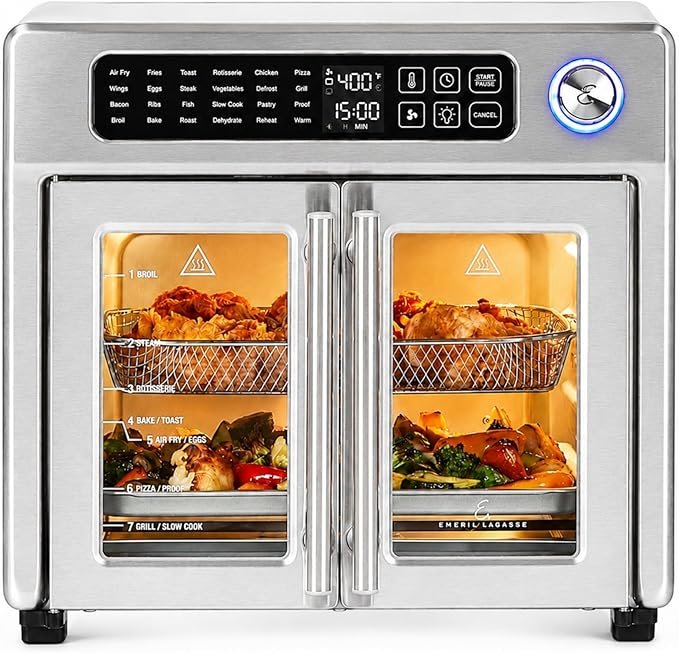
11 The countertop oven category has expanded considerably over the past several years, moving well beyond the simple toaster oven that once handled little more than reheating pizza slices and toasting bread. Today’s larger multi-function units aim to replace, or at least supplement, a full-size oven for many everyday cooking tasks, combining air frying, baking, roasting, and other functions into a single countertop appliance. The Emeril Lagasse 26QT French Door Multi-Function Air Fryer Toaster Oven is one example of this larger, more capable category, distinguished in part by its sizable 26-quart interior and French door opening style.
This article looks closely at what this appliance offers, how its various functions tend to work in day-to-day cooking, who might find a unit this size and scope useful, and some practical factors worth thinking through before making room for it in a kitchen. As with any large countertop appliance, understanding both its capabilities and its space requirements up front makes for a more informed decision.
At 26 quarts, this unit sits toward the larger end of the countertop oven and air fryer category. This capacity is generally large enough to accommodate a whole chicken, a full sheet pan of vegetables, multiple layers of food using included racks, or a moderately sized batch of baked goods, making it more comparable in scale to a small conventional oven than to a compact single-basket air fryer.
This larger capacity is a meaningful factor for families or anyone who regularly cooks for more than one or two people, since compact air fryers, while convenient for smaller portions, often require cooking in multiple batches to feed a larger household.
Rather than a single pull-down or swing-open door, this model uses a French door style, meaning it opens from the center outward with two separate door panels. This design choice is generally intended to make loading and removing food easier, particularly for larger items like a whole chicken or a large sheet pan, since a French door layout can provide a wider, more direct line of access to the interior compared to a single door that swings entirely to one side.
With 24 distinct cooking functions built in, this appliance is designed to handle a wide range of cooking styles beyond basic air frying. While the exact list of functions can vary, this category of multi-function ovens typically includes settings such as air fry, bake, broil, toast, roast, rotisserie, dehydrate, reheat, and slow cook, among others. Having this many dedicated presets is intended to simplify the process of selecting appropriate time and temperature settings for different types of food, rather than requiring manual calculation for each cooking method.
A rotisserie setting is included, which allows for slow, even cooking of whole chickens or other roasts on a rotating spit. This method is generally valued for producing evenly browned, self-basting results, since the constant rotation allows fat and juices to circulate over the meat as it cooks, rather than pooling on one side as it would in a stationary roasting setup.
The dual-speed fan is designed to circulate hot air at different rates depending on the cooking function selected. Higher fan speeds are generally associated with air frying, where rapid air circulation is what creates the crisping effect similar to deep frying, while lower fan speeds may be used for functions like baking or slow cooking, where gentler, more even heat distribution is preferred over aggressive air movement.
Ovens in this category typically come with a range of accessories suited to its various functions, which for a unit like this often includes items such as wire racks, a rotisserie spit and forks, a drip tray, and air fry baskets or trays. These accessories are generally what allow the 24 different cooking functions to actually be put into practice, since each cooking mode often pairs with a specific accessory best suited to that method.
Air frying for lower-oil cooking. The air fry function uses rapid hot air circulation to crisp the exterior of foods like chicken wings, French fries, or breaded vegetables, generally requiring significantly less oil than traditional deep frying while still achieving a comparably crisp texture.
Whole meal roasting. Given its larger interior capacity, this oven is well suited to roasting a whole chicken, a rack of ribs, or a tray of root vegetables, offering enough space to cook a complete protein-and-side combination without needing to run multiple separate cooking cycles.
Rotisserie-style whole chicken or roasts. The rotisserie function allows for a more hands-off approach to achieving evenly cooked, self-basted results, which can be a useful alternative to traditional oven roasting for those who prefer the texture and flavor rotisserie cooking tends to produce.
Everyday toasting and reheating. Beyond its larger cooking functions, this appliance still handles basic toaster oven tasks like toasting bread, reheating leftovers, or warming up pre-cooked foods, functioning as a multi-purpose replacement for a standalone toaster or microwave in some households.
Baking in a countertop-sized format. With bake settings included among its 24 functions, this oven can handle tasks like baking cookies, small cakes, or casseroles, which can be particularly useful during warmer months when some cooks prefer to avoid heating up a full-size oven for smaller baking tasks.
Dehydrating for snacks and food preservation. If a dehydrate function is included among the 24 modes (as is common in this category of multi-function ovens), it can be used for tasks like making dried fruit, jerky, or dehydrated vegetables, extending the appliance’s usefulness beyond typical daily cooking into food preservation territory.
Larger households or families who regularly cook full meals are likely to benefit most from the 26-quart capacity, since it reduces the need for multiple cooking batches that smaller air fryers often require when preparing food for more than two or three people.
Those looking to consolidate multiple kitchen appliances into one may find the 24 cooking functions appealing, since a unit like this is designed to take over tasks otherwise split across a separate toaster, air fryer, rotisserie oven, and dehydrator.
Cooks who want to avoid heating a full-size oven for smaller tasks might appreciate having a countertop alternative capable of baking, roasting, or air frying without needing to run a large conventional oven, which can also have modest energy-use benefits for smaller-portion cooking.
Those who enjoy rotisserie-style cooking at home without wanting a separate, single-purpose rotisserie appliance may find this multi-function approach practical, since the rotisserie setting is built into a broader, more versatile unit.
That said, kitchens with limited counter space should think carefully before choosing a unit this large, since a 26-quart interior generally corresponds to a fairly substantial exterior footprint, both in terms of counter space and vertical clearance needed for the French doors to open fully.
Counter Space and Clearance
This is one of the most important practical factors to weigh before purchase. A 26-quart oven is considerably larger than a standard toaster oven or compact air fryer, and the French door design requires clearance space in front of the unit for both doors to swing open fully. It’s worth measuring your intended counter space, including height clearance beneath cabinets, before committing to a unit this size.
Weight and Portability
Larger multi-function ovens tend to be heavier than compact countertop appliances, which is worth factoring in if you anticipate needing to move the unit frequently, whether for cleaning, storage, or repositioning around a kitchen.
Learning the Full Function Set
With 24 distinct cooking functions, there’s likely to be a learning curve involved in understanding which setting is best suited to a given dish, particularly for functions beyond the more familiar bake, toast, and air fry options. Reading through the included manual and experimenting with a few functions early on can help build familiarity more quickly than guessing at settings recipe by recipe.
Preheating and Cooking Time Differences from a Conventional Oven
Countertop ovens, including larger multi-function models, often heat up faster than a full-size conventional oven due to their smaller interior volume, but actual cooking times for specific recipes may still differ from full-size oven instructions. It’s generally a good idea to check food for doneness a bit earlier than a standard recipe might indicate, at least until you become familiar with how this specific appliance performs.
Cleaning a Larger Interior
A bigger interior cavity, while useful for larger food quantities, also means more surface area to clean, particularly after air frying or rotisserie cooking, both of which can produce more splatter than simple baking or toasting. Checking which accessories are dishwasher safe, and understanding the interior cleaning process, is worth doing before regular use begins.
Electrical and Ventilation Considerations
Given the higher wattage typically associated with larger multi-function ovens, it’s worth confirming that your kitchen’s electrical setup can comfortably support the appliance, and ensuring adequate space around the unit for proper ventilation during operation, since restricted airflow can affect both performance and appliance longevity.
Understanding how this larger multi-function model compares to other general categories of countertop cooking appliances can help clarify where it fits, without directly comparing it to specific competing products.
Compact Single-Basket Air Fryers These smaller units are generally well suited to individuals or couples cooking smaller portions, offering quick air frying capability in a smaller footprint, but they typically lack the capacity for whole chickens, large sheet pans, or multi-rack cooking that larger combination units provide.
Standard Toaster Ovens Basic toaster ovens tend to focus on toasting, baking, and light reheating without the air frying or rotisserie functions found in more advanced multi-function models. They’re generally more compact and often more budget-friendly, but offer a narrower range of cooking capabilities overall.
Large Multi-Function Combination Ovens This category, which includes the Emeril Lagasse 26QT model, aims to bridge the gap between a compact air fryer and a full-size conventional oven, combining air frying, baking, roasting, rotisserie, and other functions into one larger countertop unit. The tradeoff for this added capability and capacity is a larger footprint and, generally, a higher price point compared to single-function or compact appliances.
Full-Size Conventional Ovens Built-in, full-size ovens obviously offer the largest capacity and are standard in most kitchens for larger-scale cooking and baking. Countertop multi-function ovens like this one aren’t generally intended to fully replace a conventional oven but rather to supplement it, offering a faster-heating, often more energy-efficient option for smaller to medium-sized meals or when avoiding the extra heat output of a full oven is preferable.
Each category serves a different scale of cooking need, and the right choice tends to depend on household size, available counter space, and how much you’re looking to consolidate multiple appliances into one unit.
Can this oven really replace a conventional oven? For many everyday cooking tasks — roasting, baking, air frying — a large multi-function oven like this one can serve as a practical alternative to a conventional oven, particularly for small to medium portions, though very large-scale cooking or baking may still be better suited to a full-size oven.
How much counter space does a 26-quart oven typically require? Given the larger interior capacity and French door design, this type of appliance generally requires a fairly substantial amount of counter space, including clearance for the doors to open, so it’s worth measuring your available space carefully before purchase.
What is the benefit of a French door design over a single door? French doors open from the center outward, which can provide easier, more direct access to the interior for loading and removing larger items like a whole chicken or a large sheet pan, compared to a single door that swings entirely to one side.
Does the rotisserie function require a separate accessory? Yes, rotisserie cooking typically requires a spit rod and forks, which are generally included as accessories with ovens that offer this function, allowing the food to rotate during cooking.
Are all 24 cooking functions necessary for everyday use? Not necessarily — many users primarily rely on a handful of core functions like air fry, bake, roast, and toast for regular use, while occasionally exploring additional functions like dehydrate or slow cook for specific recipes or needs.
Is this appliance energy efficient compared to a full-size oven? Countertop ovens generally use less energy than heating a full-size conventional oven, particularly for smaller cooking tasks, since they have a smaller interior volume to heat and often preheat more quickly, though exact energy use will vary based on usage patterns and specific cooking functions selected.
The Emeril Lagasse 26QT French Door Multi-Function Air Fryer Toaster Oven represents a larger, more capable segment of the countertop oven category, combining a substantial 26-quart interior, a French door design intended for easier loading, and 24 distinct cooking functions that span everything from air frying and baking to rotisserie cooking. For households looking to consolidate multiple kitchen appliances into one versatile unit, or for those cooking regularly for a larger family without wanting to rely solely on a full-size oven, this type of appliance offers a fairly comprehensive set of capabilities.
As with any large countertop appliance, it’s worth carefully weighing your available kitchen space, household cooking volume, and how many of the 24 functions you’re realistically likely to use on a regular basis before deciding if this particular model fits your needs. A unit of this scale represents a meaningful commitment of both counter space and budget, so taking the time to consider your household’s actual cooking habits can help ensure it becomes a regularly used tool rather than an oversized appliance taking up valuable kitchen real estate.